
Table of Contents
You typed a search for this old Las Vegas landmark, hoping for a quick answer, and instead found scattered facts, mismatched dates, and pages that never seem to agree with each other. That kind of mess is common, and many curious visitors hit the same wall when they try to learn about this vanished part of the Strip.
This guide clears up that confusion. Below, you get the full story of boardwalk casino vegas, from its early days as a small Holiday Inn to its final implosion in 2006, along with facts most other pages skip entirely.
What Was the Boardwalk Hotel & Casino?
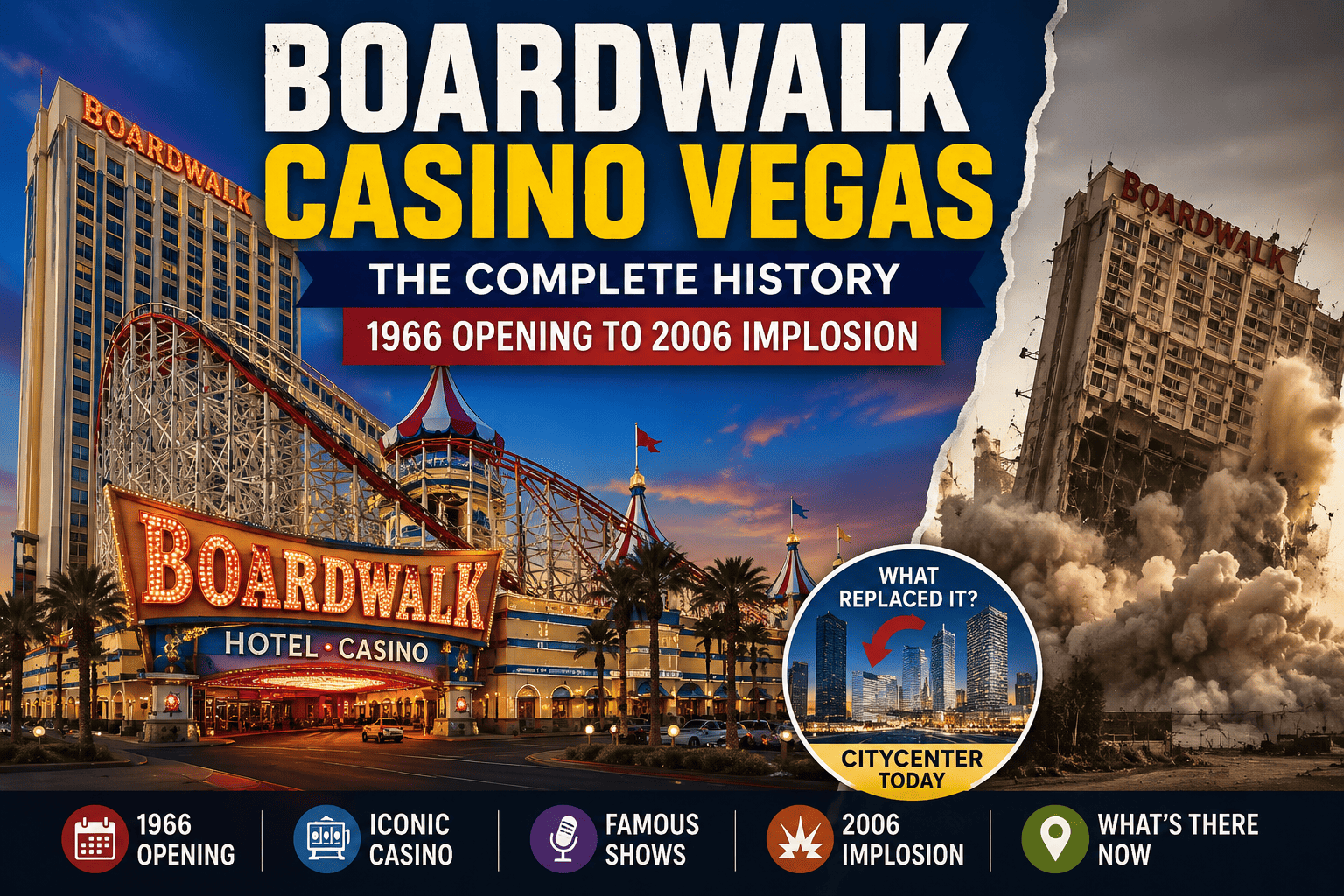
The Boardwalk Hotel and Casino was a mid-size resort on the Las Vegas Strip. It sat between Bellagio and what is now Park MGM. The property carried a Coney Island theme, complete with a fake wooden roller coaster on its front wall.
If you are searching for boardwalk casino vegas today, you should know it no longer exists. The resort closed in January 2006 and was demolished a few months later. Its old address is now part of the CityCenter complex.
For decades, the site drew guests who wanted an affordable Strip stay. Cheap rooms, cheap food, and a fun exterior made it stand out next to bigger neighbors.
People search for boardwalk casino vegas for a few different reasons. Some remember staying there decades ago and want to confirm what happened to it. Others simply stumble across old photos online and get curious about the carnival-style building. Whatever brought you here, the sections below walk through every stage of its story in order.
History and Timeline of the Boardwalk Hotel & Casino
The story of boardwalk casino vegas spans four decades and several name changes. Each stage added something new to the property, until it finally grew into the resort people remember today. Unlike many Strip properties that opened once and simply expanded, this one changed hands, changed names, and changed themes multiple times before settling into its final identity.
Understanding this timeline also explains why old records sometimes list different opening years or room counts. The property was really three different buildings joined together over time, and each expansion added its own set of numbers to the history books.
Origins as a Holiday Inn (1966)
The property opened in 1966 as a small Holiday Inn hotel. It had about 138 rooms, a restaurant, and a small meeting space. Architect Homer Rissman designed the original building.
A second tower opened in 1968, called the Luna Park tower. This expansion pushed room capacity higher and set the stage for future growth. At the time, gaming was not yet part of the property.
In 1972, owner Norbert Jansen added a small gift shop called Holiday Gifts. That tiny shop later grew into a slot parlor known as Slot Joynt. This small casino would eventually merge with the hotel itself.
Jansen had previously owned the Pioneer Club downtown before turning his attention to this Strip property. His wife Avis pushed for gaming rights early on, but regulators denied her request in 1977 due to her husband’s past business history. It would take a few more years before gaming truly took hold on the property.
Renamed the Viscount Hotel (1985)
In 1985, Jansen renamed the Holiday Inn as the Viscount Hotel. At that point, the property had six stories and 204 rooms. It joined a chain with over a dozen other Viscount locations across the country.
This period also brought talk of a bold idea. Jansen proposed building a 21-story working slot machine in front of the casino. County officials rejected the plan due to rising costs.
Becoming the Boardwalk Hotel & Casino (1989)
In February 1989, Jansen merged the Viscount and Slot Joynt into one property. He renamed it the Boardwalk Hotel and Casino. The name stuck, even though it sometimes appeared as Holiday Inn Boardwalk in later years.
Boardwalk Casino Inc. became a public company in 1994. That same year, the resort rejoined the Holiday Inn franchise. Soon after, the Coney Island theme arrived, giving the building its signature carnival look with a faux roller coaster and parachute-drop ride.
A 15-story tower opened in 1996, bringing the resort to 653 rooms. The casino floor grew alongside it. This was the version of boardwalk casino vegas that most longtime visitors remember best.
Sale to Mirage Resorts and MGM Mirage (1998–2000)
In December 1997, Mirage Resorts agreed to buy the Boardwalk along with nearby land. Nevada gaming regulators approved the sale in 1998. The deal was worth roughly one hundred million dollars.
Mirage Resorts merged with MGM Grand in 2000, forming MGM Mirage. The new owner dropped the Holiday Inn branding shortly after taking over. From that point on, the property operated simply as the Boardwalk Hotel and Casino under MGM ownership.
For a few years after the sale, MGM Mirage kept the resort running largely unchanged. Company leaders focused their attention on the newly built Borgata resort in Atlantic City instead. That delay meant the Boardwalk stayed open longer than some expected, giving guests several more years to enjoy its carnival charm before redevelopment plans finally moved forward.
Rooms, Casino Size and Amenities
Despite its playful exterior, boardwalk casino vegas offered real Strip-level amenities. Guests found a mix of budget comfort and classic Vegas gaming inside, without the high prices attached to nearby megaresorts.
The property never tried to chase luxury travelers. Instead, it focused on families and budget-minded visitors who wanted a central Strip location without paying premium rates. That approach shaped every part of its room design, casino floor, and dining choices.
Room Count and Tower Additions
The resort grew in stages. It started with just over 100 rooms and eventually reached 653 by the mid-1990s. Three separate buildings made up the final layout, built at different points in the property’s history.
Rooms were simple but comfortable. Standard amenities included air conditioning, cable television, and coffee makers. The price stayed low compared to nearby megaresorts, which is part of why guests kept coming back.
The three buildings that made up the resort each carried their own character. The original Luna Park building felt older and more modest, while the newer 1996 tower offered updated furnishings and better views of the Strip. Guests booking rooms often requested the newer tower specifically for this reason.
Casino Floor and Gaming Options
The casino floor expanded from 15,000 square feet to 33,000 square feet after the 1996 renovation. It offered around 20 table games and hundreds of slot machines. Table limits were famously low, often starting at just three dollars.
Penny slots and low-limit tables gave budget-minded players a place to play without pressure. This approach set the Boardwalk apart from luxury-focused resorts nearby. Table games included blackjack, roulette, and craps, spread across a floor that never felt overwhelming or crowded like some of the larger casinos on the Strip, a kind of game variety that modern platforms still try to recreate for today’s players.
A race and sports book was also part of the casino, giving guests another reason to stay on property instead of walking to a bigger resort. The relaxed, low-pressure gaming floor became one of the property’s defining traits over the years. Anyone comparing gaming options today can see how the industry has shifted toward sites like Scrooge Casino, which now offers a wide range of sweepstakes-style games for players who still enjoy that same low-stakes, high-fun approach without needing a trip to the Strip at all.
The Surf Buffet
The Surf Buffet was one of the property’s most talked-about features. It ran 24 hours a day starting in 2003, a rare offering on the Strip at that time. Prices stayed under six dollars for years.
A television commercial featuring boxer Butterbean helped make the buffet locally famous. Many guests remember it as the reason they chose the Boardwalk over other budget hotels nearby.
The buffet offered a mix of American comfort food, seafood, and dessert stations. Late-night diners especially appreciated the round-the-clock hours, since few other Strip properties offered affordable food after midnight. For many families on a budget, this single amenity justified the entire stay.
Entertainment at the Boardwalk
Beyond gaming and dining, the Boardwalk built a loyal following through its live shows. The 100-seat Lighthouse Showroom hosted several memorable acts over the years. Even comedian The Unknown Comic made an appearance there in the mid-1990s, adding to the venue’s reputation for offbeat, entertaining programming.
Trent Carlini’s Elvis Tribute Show
Elvis impersonator Trent Carlini performed at the Boardwalk from 1996 to 2001. His show ran in the Lighthouse Showroom and drew steady crowds. For part of that run, he shared the stage with magician Dixie Dooley.
Carlini went on to build a wider reputation as one of the top Elvis tribute performers in the country. His time at the Boardwalk helped launch that career, and he continued performing on the Strip for years after leaving the resort. Fans of his act often trace their first exposure back to those early Lighthouse Showroom nights.
Purple Reign — Prince Tribute Show
Purple Reign, a Prince tribute act, took over the same venue from 2001 until the resort closed in 2006. The show later moved to another Strip property and continued performing for years afterward. It remains one of the most remembered pieces of the Boardwalk’s entertainment legacy.
How the Boardwalk Compared to Other Las Vegas Strip Resorts
The Boardwalk never tried to compete with luxury giants. Instead, it carved out its own lane. Here is a quick comparison to show where it stood among its Strip neighbors.
| Feature | Boardwalk Hotel & Casino | Bellagio | MGM Grand |
|---|---|---|---|
| Rooms | 653 | Over 3,900 | Over 5,000 |
| Theme | Coney Island carnival | Italian luxury | Modern city resort |
| Table limits | Low, often $3 | High-end tables | Wide range |
| Price point | Budget-friendly | Premium | Mid to high |
| Dining highlight | 24-hour Surf Buffet | Fine dining | Multiple celebrity chef spots |
This table shows why the Boardwalk stood out. It was not trying to be the biggest or fanciest. It was built for guests who wanted fun, low-cost entertainment close to the action.
Bellagio opened its doors with world-famous fountains and an art gallery, aiming squarely at high-end travelers. MGM Grand leaned into scale, offering thousands of rooms and a full entertainment complex. The Boardwalk took the opposite approach, staying small and leaning into charm instead of size. That contrast is part of why longtime locals still bring it up when talking about how much the Strip has changed, and why players today prefer platforms that bring back that same relaxed, low-pressure style of play without needing a hotel room at all.
Notable Incidents and Little-Known Facts
A few lesser-known stories add depth to the boardwalk casino vegas history. These details rarely appear together in one place, and most casual write-ups skip them entirely in favor of just covering the opening and closing dates.
The 1966 Labor Union Picketing
Shortly after opening, hotel employees represented by the Culinary Workers Union began picketing outside the property. They claimed wages and conditions fell below local standards. Holiday Inn management denied the claim, and the union eventually lost the dispute.
The picketing lasted several months and made local headlines at the time. It reflected wider labor tensions across the growing Las Vegas hotel industry during the 1960s, as new properties raced to open while unions pushed for better standards across the Strip.
The 1975 Hotel Fire
In October 1975, a fire broke out on the fifth floor, believed to have started from a cigarette. The hotel’s innkeeper died in the blaze. Damage was estimated near forty thousand dollars, and about ten guests needed treatment for smoke inhalation.
The Failed Giant Slot Machine Proposal (1989)
One of the strangest chapters involved a plan for a 21-story working slot machine, meant to be the largest in the world. Clark County officials initially rejected the idea, though it later gained approval. Jansen scrapped the plan anyway after costs climbed from five million to seven million dollars.
Jansen later reflected on the idea in a 1995 interview, admitting the project was probably never going to happen in his lifetime. He passed away from cancer in January 1997, just a few years before the resort changed ownership completely. The giant slot machine remains one of the more colorful what-if stories in Las Vegas Strip history.
Why Did the Boardwalk Casino Close?
MGM Mirage closed the resort on January 9, 2006. The land was needed for CityCenter, a massive new development planned for the same stretch of the Strip. At 8 acres, the Boardwalk site was simply too valuable to keep as a small themed casino.
This is the core reason anyone researching boardwalk casino vegas eventually finds. The property was not struggling financially when it closed. It was simply standing in the way of a much larger project.
Employees and longtime guests treated the closure as the end of an era. Local columnists described it as one of the last truly playful, unpretentious spots left on the Strip.
At the time of closure, the resort still employed around 650 people. Many of them had worked there for years and remembered the property fondly, even as they moved on to jobs at other Strip resorts. The closure date was announced months in advance, giving guests and staff time to say their goodbyes before the doors shut for good.
The Boardwalk Implosion (May 9, 2006)
The main hotel tower came down early on the morning of May 9, 2006. Controlled Demolition Inc. handled the implosion. It took only seconds to bring down a building that had stood for decades.
Much of the debris was recycled and reused. Some materials became part of the CityCenter foundation itself. Other pieces, like glass and bathroom fixtures, were shipped overseas for reuse in other construction projects.
Crowds gathered nearby to watch the demolition, as is common with Strip implosions. Within seconds, decades of history collapsed into a pile of rubble and dust. Cleanup crews spent weeks clearing the site before construction on CityCenter could begin in earnest.
What Happened to the Boardwalk’s Memorabilia
Former Nevada lieutenant governor Lonnie Hammargren, a well-known collector of Vegas history, purchased several pieces before the implosion. He saved the resort’s Ferris wheel, a Surf Buffet sign, the wedding gazebo, and a 15-foot lighthouse. The building’s giant clown-face facade, however, was demolished along with the rest of the structure.
What Occupies the Boardwalk Site Today?
The old boardwalk casino vegas location is now part of CityCenter, one of the largest private developments in U.S. history. The Waldorf Astoria Las Vegas currently sits on part of the former site. Nearby, Aria and The Shops at Crystals occupy adjoining land that was once part of the Boardwalk’s footprint.
CityCenter opened in phases starting in 2009. It replaced the small, budget-friendly Boardwalk with a collection of luxury towers, retail space, and high-end dining. The contrast between the two eras says a lot about how the Strip has changed.
Where guests once paid a few dollars for buffet shrimp cocktail, they now walk past designer boutiques and art installations. The transformation reflects a broader trend across the Strip, where smaller independent properties gave way to massive integrated resorts over the past two decades. Few sites illustrate that shift as clearly as this one.
The shift mirrors changes across the wider gaming industry too. Just as physical casinos evolved into massive luxury complexes, many players have also moved toward online and sweepstakes-style platforms that let them enjoy that same casual, low-stakes fun from home. Anyone curious about that shift can read more about how the sweepstakes system works to understand where casual, low-stakes gaming has landed today.
Conclusion
As promised earlier, this guide covered the full story behind boardwalk casino vegas, from its 1966 origins to its final implosion decades later. You now know why it closed, what replaced it, and the small details most pages leave out. The Boardwalk may be gone, but its playful, budget-friendly spirit still shapes how people remember the older Las Vegas Strip. Its story remains a fun reminder of how much this city keeps reinventing itself.
Frequently Asked Questions
Is Boardwalk Casino Las Vegas still open?
No, it is permanently closed. The property shut down on January 9, 2006, and the main tower was demolished that May. The former site is now part of CityCenter, home to the Waldorf Astoria Las Vegas and several other luxury properties on the Strip today.
Where was the Boardwalk Hotel and Casino located?
It stood at 3750 South Las Vegas Boulevard, directly between the current Bellagio and Park MGM properties. That stretch of land now falls within the CityCenter development, one of the largest private construction projects in United States history.
What replaced the Boardwalk Casino?
CityCenter replaced the Boardwalk, including the Waldorf Astoria Las Vegas, Aria Resort and Casino, and The Shops at Crystals. Construction began soon after the 2006 implosion, and the new complex opened to guests in phases starting in late 2009.
How many rooms did the Boardwalk have?
The resort reached 653 rooms by the mid-1990s, following its final tower addition in 1996. It started much smaller back in 1966, with just over 100 rooms inside its original small Holiday Inn building on the Strip.
When did the Boardwalk Casino close?
The Boardwalk closed permanently on January 9, 2006, to clear the way for the CityCenter project. Its main hotel tower was imploded four months later, on the morning of May 9, 2006, ending its 40-year run.